Loretto Chapel staircase
The StaircaseThe Loretto Chapel staircase is the novel’s central object of wonder: a polished wooden spiral that appears to rise without a railing or visible supports, and whose completion coincides with the carpenter’s disappearance. The nuns interpret it as the work of Saint Joseph; Lizzy Enders, who knew the carpenter as a hungry, fallible man, refuses that conclusion. The staircase therefore does more than solve the chapel’s practical problem. It makes visible the story’s enduring uncertainty about miracles, human skill, and what people choose to believe.
The staircase and the chapel’s dilemma
In the novel, the staircase is needed to connect the chapel floor to the choir loft. The nuns have been praying a novena to Saint Joseph, while Bishop Jean Baptiste Lamy admits that he cannot perform the miracles they expect of him. He offers the job to a carpenter whom Lizzy has brought back from the road: a beggar with no work, but a trade. The bishop suggests that hunger may give a man a special vision. The commission thus begins at once as practical employment and as a response to a problem already framed in religious terms.
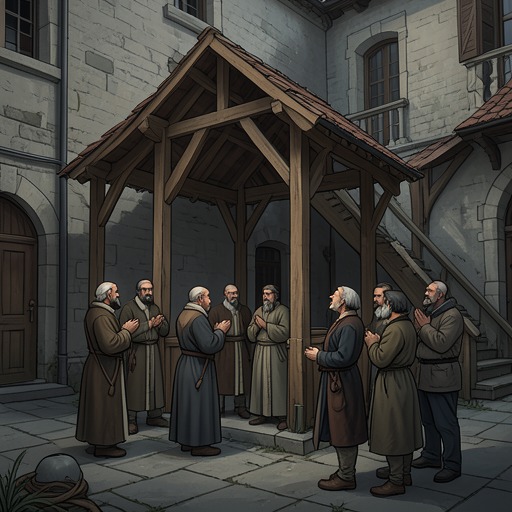
The finished staircase is revealed when Ramona goes to take the carpenter his supper and discovers that his work is complete. The carpenter himself is gone. The other girls and the nuns gather at the back of the church and look up at what he has made. It rises in a graceful, swirling circular arch from the ground to the choir loft, its polished wood glowing in the candlelight. There are thirty-three steps, each trimmed with care. Yet there is no railing and no visible support to explain how the structure holds its form.
The staircase’s appearance is both beautiful and unsettling. Its precise finish suggests patient workmanship; its apparently unsupported construction leaves the observers unable to account for what they see. Sister Roberta examines it more closely, identifying two complete turns and joints spliced in seven places on the inside and nine on the outside. She calls it incredible and impossible work, and doubts that one man could have finished it in so short a time. When Mother Magdalena asks whether it will hold, Sister Roberta volunteers to test it as the heaviest person present. The wonder is therefore not simply proclaimed: the nuns first confront a concrete question of structure and safety.
Disputed explanations
After the staircase is examined, Mother Magdalena declares that the carpenter must have been Saint Joseph. The nuns kneel and pray, treating the completed structure and the maker’s absence as confirmation of divine intervention. Their reading fits the novena that preceded the work and gives a sacred answer to the chapel’s practical need. In their account, the stranger was not merely a skilled laborer but the saint for whom they had been praying.
Lizzy does not accept that identification. She remembers a man who spoke with her, listened to her troubles, held her kitten, and offered advice about her father. He had told her that he was sad to leave his own family and had been hurt when the girls rejected him. Those memories resist the nuns’ sudden elevation of him into a saint: to Lizzy, the carpenter remains a particular person with pain and attachments. Her question about whether a saint would act as he did does not settle the matter; it shows why the same stranger and the same staircase can sustain sharply different interpretations.
The uncertainty is especially pointed because Lizzy is not simply dismissive of every possible miracle. She has little faith in uncommon powers, and she does not believe the carpenter was Saint Joseph. Yet the novel leaves open a small exception connected with the blind cat: the author’s note identifies the cat’s restored sight after the carpenter held her as the narrow opening through which Lizzy might still believe. The staircase does not resolve that tension. Its physical achievement invites amazement, while the story declines to make amazement proof of a supernatural cause.
The historical legend behind the novel
The author’s note identifies the staircase legend as the springboard for the fiction. In the historical account summarized there, the chapel’s completion in 1878 exposed a practical omission: there was no way to reach its choir loft. The Sisters of Loretto, brought to Santa Fe from Kentucky in 1852 by Bishop Jean Baptiste Lamy to run the Academy of Our Lady of Light, consulted builders, carpenters, and architects. A conventional staircase was said to take too much space; rebuilding the choir loft would be expensive, and a ladder was offered as another possibility. The sisters began a novena to Saint Joseph.
The legend then introduces a beggar carpenter who arrives with a mule and only three tools: a hammer, a T square, and a saw. Accounts differ about how long he worked, placing the construction at either two weeks or several months. When the sisters plan a feast to honor him, he cannot be found. Men at the lumberyard where Bishop Jean Baptiste Lamy had an account for him say they never saw him; he never collects his pay and is never seen again. The sisters conclude that the carpenter was Saint Joseph. The unexplained disappearance, like the seemingly impossible staircase, is a crucial part of the tradition rather than a detail the legend explains away.
The author also distinguishes the historical staircase from the novel’s version. As described in the note, the staircase at the Chapel of Loretto stands to this day and has a banister, added in 1883; the fictional staircase is first seen without one. The historical structure is described as using wooden pegs rather than nails. Architectural experts have examined it, and the author reports that they could not account for the wood used and determined that it is not found anywhere in New Mexico. These details belong to the account of the real-world legend, not to a proof of the carpenter’s identity.
A story kept open
The staircase links practical need, skilled labor, religious ritual, and the limits of explanation. In the novel, the nuns’ prayers precede the commission, the carpenter’s work answers the chapel’s need, and his disappearance immediately invites a saintly interpretation. Lizzy’s personal memories interrupt that neat sequence: she has encountered the maker as a person, not merely as the solution to a religious puzzle. The object gathers those competing accounts without choosing between them.
The author says that a 1999 visit to Santa Fe, where the staircase story was told during the ride from the airport and the staircase became an early stop on the tour, helped prompt further research at a local library. In the novel, the staircase likewise becomes a point of departure rather than a final verdict. Its thirty-three carefully finished steps can be counted; its construction can be inspected; the carpenter’s absence can be reported. Whether those facts establish a miracle remains unsettled, leaving the staircase suspended between material craft and sacred legend.